

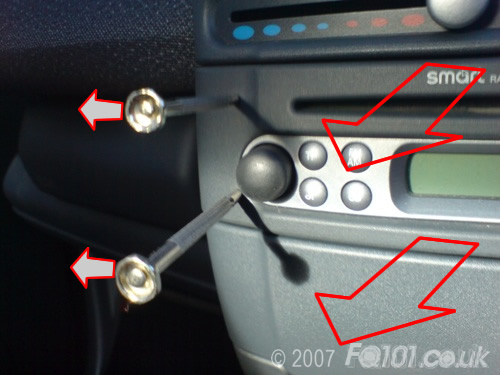
If you ever want to remove the radio but can't find the radio removal clips, then don't despair! You can use nails, precision screwdrivers, or whatever you can find to free it from the centre console.
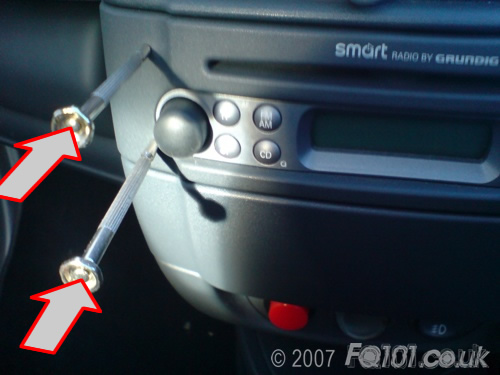
Push your 'tools' in until you feel a spring give way. Now push the tools towards the doors and pull the radio from the console.
Notice: file_put_contents(): Write of 128 bytes failed with errno=122 Disk quota exceeded in /home/u432326315/domains/fq101.co.uk/public_html/libraries/vendor/joomla/filesystem/src/File.php on line 279
Notice: file_put_contents(): Write of 128 bytes failed with errno=122 Disk quota exceeded in /home/u432326315/domains/fq101.co.uk/public_html/libraries/vendor/joomla/filesystem/src/File.php on line 279
Notice: file_put_contents(): Write of 128 bytes failed with errno=122 Disk quota exceeded in /home/u432326315/domains/fq101.co.uk/public_html/libraries/vendor/joomla/filesystem/src/File.php on line 279
Notice: file_put_contents(): Write of 128 bytes failed with errno=122 Disk quota exceeded in /home/u432326315/domains/fq101.co.uk/public_html/libraries/vendor/joomla/filesystem/src/File.php on line 279
Notice: file_put_contents(): Write of 128 bytes failed with errno=122 Disk quota exceeded in /home/u432326315/domains/fq101.co.uk/public_html/libraries/vendor/joomla/filesystem/src/File.php on line 279
Notice: file_put_contents(): Write of 128 bytes failed with errno=122 Disk quota exceeded in /home/u432326315/domains/fq101.co.uk/public_html/libraries/vendor/joomla/filesystem/src/File.php on line 279


